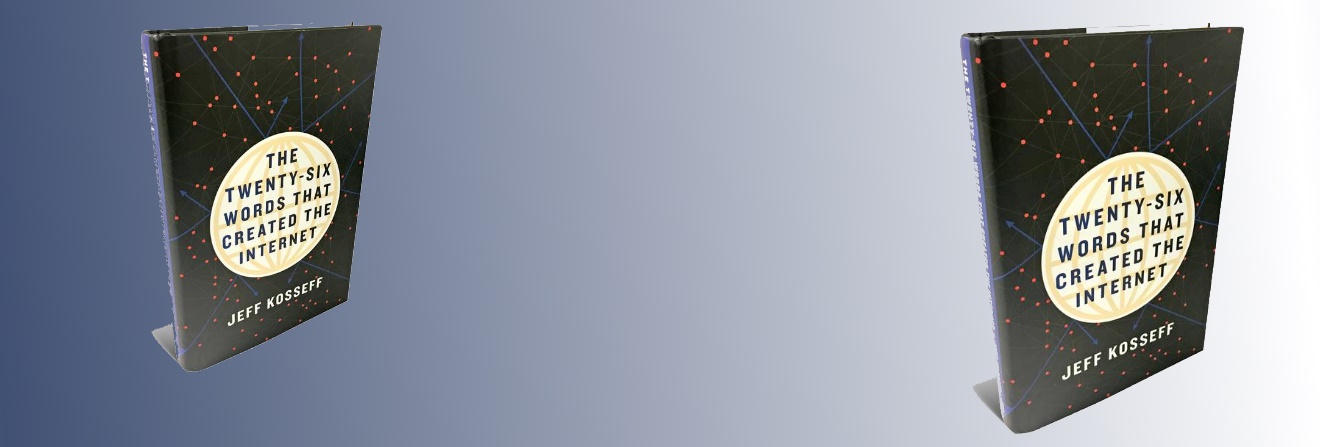
Review of The Twenty-Six Words that Created the Internet by Jeff Kosseff (Cornell University Press 2019)
The Twenty-Six Words that Created the Internet by Jeff Kosseff, cyber-security law professor at the U.S. Naval Academy, was one of the most amazing new publications in 2019, but more for reasons unintended than intended.
One of the book’s most important lessons is already indicated by its title. It’s not the economy, nor technology, neither the code (as Lawrence once claimed with his title “The Code is Law”). To the contrary, It is law which shapes industry evolution at large scale! Without Section 230 of the US-Communication Decency Act and corresponding rules all over the world, the internet as we know it today would not exist. Without section 230, the internet would resemble something like a digital newspaper. Social networks and user-generated content wouldn’t exist. In a programmatical reading, Kosseff’s book gives reasons for optimism: By installing adequate laws, politics indeed is able to shape the impact which technology has upon society! But let’s see how this works out for the American way of dealing with the law.
Section 230 is a blanket exemption for Internet intermediaries from any liability concerning the contents published by its users:
“No provider or user of an interactive computer service shall be treated as the publisher or speaker of any information provided by another information content provider.”
The really astonishing thing is: Section 230 means what is says! Although Kosseff’s book is intended as a defence of 230, it reads as a bizarre collection of court cases where, in the name of free speech, helpless victims of online defamation are denied support by the courts.
Just take one of the many examples provided by Kosseff: Zeran vs. America Online, where, six days after the Oklahoma City bombing in 1995, an anonymous user posted a publicly available notice on an AOL-bulletin board. In that notice, he accused Kenneth M. Zeran – a nobody, until then – of being involved in selling T-shirts with slogans which glorified the bombing. The posts also contained Kenneth’s phone number and encouraged other users to call him in order to protest against his sales activities. Although none of the accusations were true, Kenneth M. Zeran became a victim of a witch-hunt. The courts, though, contrary to any common sense, didn’t see anything wrong with this, because the Communications Decency Act clearly stated that AOL was neither responsible for monitoring user-generated content nor taking that content down (after being informed by the victim).
The Twenty-Six Words that Created the Internet is a very detailed reconstruction of court cases that preceded, motivated, and followed upon Section 230, starting with the story of a bookshop owner convicted for selling books about the pornographic content of which he was not informed. What becomes clear, though, is that law as it is practised in the US does a very poor job when it comes to setting a political strategy. The one thing special about the US legal system is the prominent role played by rather simple and often famous snippets of text, be it in the Constitution or in other central legal documents. Around these simple snippets, one finds a history of court decisions, which, in sum, constitute the real world’s legal framework. This approach, known as “case law”, stands in stark contrast to the way the EU deals with legal rules. Infamous for their lack of sex appeal, the EU’s regulations are so full of details that they are hardly intelligible to ordinary folks. On the other hand, they give a much stricter orientation for the judges than, for instance, Section 230 does – leaving it to the courts to strike a balance between free speech and commerce on the one hand and unintended consequences of freeing Internet intermediaries from any liability on the other.
In fact, this balance has hardly been achieved in the past, as the cases presented by Kosseff demonstrate. Worse: The cases reconstructed in depth by Kosseff bear witness of how the judges’ individual idiosyncrasies and constellations of the moment lead to rules which affect future cases in ways not foreseeable. Defamation, hate speech, pornography: these are the sole topics the judges in Kosseff’s book are dealing with. But Section 230, certainly, and freedom of speech have also had an impact upon copyright violations and the evolution of the so-called gig economy, where companies like Uber, who act as service providers, pretend as if they were just intermediaries, without any responsibilities for clients and workers. These topics are hardly mentioned in the book, and this is a serious omission. As Netopia has written before:
Freedom of speech is the right to express your own opinion. It’s not the right to distribute other people’s works and expressions against their will. It’s not the right to operate a taxi service without following taxi service rules. It is not the right for a machine to distribute any data without restriction.
Another aspect where judges at court might have too limited a view of the system as a whole is when it comes to impacts for society. Freedom of speech is great and an important individual right. But what if freedom of speech is guaranteed in such a way that democratic discourse and the public sphere as such suffer? Shouldn’t freedom of speech be seen in that broader societal perspective rather than just as an individual right? What kind of regulation would be apt for intermediaries if the goal were to create a Citizens’ Internet? For Kosseff and the adherents of a full-flavoured Section 230 free-speech approach, this just is a non-topic.
A last point: Section 230 often is credited with being in support of “neutral” information. Rightly so: a certain idea of neutrality surely is one of the cornerstones when it comes to ensuring that intermediaries such as social media, which provide most of the stage for today’s political discourse, act in line with public interest. Wikimedia, for instance, on its information site on the topic of “Intermediary Liability” and Section 230, is eager to point out the following:
Neutral online platforms and publishers are critical to the free exchange of knowledge, on Wikipedia and elsewhere.
Neutral platforms are critical. But in fact, many of them are not neutral. And Kosseff is honest enough to point out that neutrality never was part of the idea behind Section 230. Thus, his recent statement in an interview:
All I can say is I’ve spoken with […]Senator Wyden and former Congressman Cox who wrote the bill, and they say that’s not true [the idea was that Section 230 granted special immunity to internet platforms but only on the condition that they are politically neutral]. I also spoke with the lobbyists who were on the civil liberties side and the tech companies’ side at the time [and]… they also told me that’s not true.
Personally, Kosseff confesses that he doesn’t regard it as realistic or possible that intermediaries such as Facebook could try to enact political influence: This hardly needs a comment. Facebook’s and other Internet intermediaries’ impact and biasing influence on elections have been a recurring topic both in the news and in research. To think that “free speech” will take care of itself is not only naïve or stupid. It is dangerously misleading.
Editor’s note: The author Jeff Kosseff has expressed that this review does not accurately represent the thinking in the book and that there are factual errors. Netopia has invited Jeff Kosseff to publish his comments.