Author Archive

Is Social Media Killing the Truth?

Wednesday, January 13th, 2016

Yes, new technologies have been normalized before, but that is not a case contra regulation but pro.

Steven Johnson is an American author of many books on technology. Some of them are great books, I used to be a big fan of his. Still am to some extent. Johnson’s Everything Bad Is Good for You (Riverhead 2005) busted the myth that popular culture makes us dumber, inThe Entrepreneurial State fact – argued Johnson – it makes us smarter because of its increasing complexity (take video games – look at Pac-Man and Minecraft). I bought boxes of that book and gave to anyone interested, including the Swedish Minister for Culture. I can go on about Johnson’s writing, but you get the idea. Good stuff. However, recently I find myself disagreeing with my former icon more and more. First was the data-over-reality-approach in Johnson’s NY Times piece The Creative Apocalypse That Wasn’t, where he argued that creators don’t really suffer in the digital era after all. Many people smarter than this writer have countered his argument (here’s Robert Levine’s take), but let me say that it’s wishful thinking dressed up as an economic argument, and given the huge increase in the public appetite for entertainment and creative content, creators should really be seeing a proportionate growth in income (and not just not-too-much-less-than-before-digital).

Last week, Steven Johnson published a new thought-piece which I also can’t agree with, this time on social media. Johnson’s point is that with the democratized digital public sphere, we have to take the bad – ISIS beheading videos, Putin propaganda, rape threat campaigns and, Johnson’s example, the Trump-candidacy – with the good, the latter which Steven Johnson illustrates mainly with President Obama’s successful policy results (health insurance, normalization of US-relations with Iran and Cuba, the Paris climate deal etc). His basic point is that increased connectedness and more information is a priori positive, and he seems to expect benefits to increase over time. This is the classic Silicon Valley-argument: if you just leave the internet alone, everything will be fine. Many objections to this techno-centric view can be made. Social media did not bring the Arab spring, as Netopia-contributor Mariam Kirollos has demonstrated (we did not use to talk about “poster-revolutions” and most people on Tahrir square did not have internet connection in the first place). Oppressive regimes use social media for disinformation and to spy on and hunt down dissidents, often with the support of Western tech companies. Invasion of privacy happens on a massive scale in the surveillance economy – Steven Johnson fails to mention Snowden – but even if we were to trust GAFA with our information, once collected it can and will fall into the hands of others. Filter bubbles – personalized services means my internet is different than yours – play a part in spreading conspiracy theories. And so on.

Do we have social media to thank for Obama’s progressive policies? (Or blame, depending on your own politics) Who can tell? Perhaps they would have happened anyway, perhaps not. But let’s look at Steven Johnson’s history argument:

[…] all the step changes in human connection over the eons — from scrolls to the printing press to the pamphleteers to the newspapers. Yes, each transition had its own particular form of tumult, and each undermined its fair share of existing authorities, but with the hindsight of centuries, they are all now considered to be fundamentally on the side of progress: democratizing the flow of information and decision-making in society, and increasing the quality of those decisions. No one is hankering to rewind the clock to, say, the media of the 16th-century: post-Gutenberg, but pre-pamphleteers.

Yes, there is progress through technology, but Johnson falls into the trap of assuming that society evolved by getting used to the new things, by adjusting and embracing. That is simply not true. Each of these technologies also bred new institutions, law, codes of ethics, certifications and so on. The printing press brought copyright, freedom of expression, press ethics and many other structures. Radio brought public service media, spectrum regulation and broadcast licenses. The combustion engine brought the traffic system: lights, lanes, signs, rules, drivers licenses, smog checks, you name it! The way society makes new technologies useful is not simply by getting used to them, but by introducing regulation systems. Checks and balances, if you will. There is no reason social media should be any different. It’s much too important to be left to a handful of companies to regulate.

The other pitfall is to see technology out of context. The formula “technology happens – impacts society” is fundamentally flawed (and I am in part guilty of that same sin in the previous paragraph). Technology is the result of many factors: inspiration, government action, business interests, vanity, chance, ambition… The space race in the 60’s was a consequence of the Cold War super powers’ battle for prestige, it brought technological progress, not the other way around. The internet started as a military research project in the same era. (Innovation professor Mariana Mazzucato has a great book on this topic: The Entrepreneurial State)

In his ambition to be an optimist, sadly my old idol Steven Johnson turns himself to a parrot for Silicon Valley’s spin to avoid necessary regulation.

The real question is how we best secure that the online space contributes to truth, growth and progress. (Coincidentally, Netopia has a report on that!)

Netopia’s #DigitalSingleMarket Xmas Wish

Thursday, December 10th, 2015

Dear Father Christmas,

I have been a good online publication all year, dutifully covering the digital policy issues, interviewing decision-makers, tweeting opinions, did all my homework and ate my peas every day. Can I make a wish for Christmas, please?

I wish for a digital single market strategy. One that builds on Europe’s strengths and opportunities. That seizes the digital opportunity to create jobs, growth and culture, so that all good children can have many merry Christmases from now on.

I wish for a digital single market strategy that doesn’t knock the values of cultural diversity, creativity and intellectual efforts. One that does not build on the faith economics of digital abundance, nor gives away the works of European creators to the freenomics of big data companies or underestimates the strength and value of territorial licensing, so that all the good children can enjoy merry Christmas entertainment that is tailored to local taste and a wealth of quality content.

I don’t wish for portability of services or more exceptions to copyright, but a digital single market that puts the onus on the digital distributor to obtain licenses and share revenue with creators, so that also the good children of the European authors can eat plenty of heavy food this holiday season and the next, in infinity.

I wish for a digital single market strategy that provides European startups with access to venture capital so they can pay for the content they want to use and not have to say bad words like “permissionless innovation”. I wish for action from the search companies, platforms and internet companies so that the creators won’t have to see their profits go to illegal competitors and the legal content services can prosper. And I wish for better payment systems and rights clearance so the digital content markets can function. I wish the illegal services a boring Christmas with family fights, cold glühwein and nothing but cabbage to eat.

And I wish for a digital single market which takes hate speech seriously, that sees editorial responsibility and protection of sources as a better solution to privacy online than anonymity. And I wish for social media platforms better moderation to avoid filter bubbles, radicalization and recruitment of terrorists.

My wish this year is for a better vision of the digital single market, Father Christmas. If you grant it, I promise to be a good online publication all of next year and I think you will agree it will give a better online society, create lots of jobs and much-needed growth for Europe, as well as great culture and entertainment to keep us happy in our free time.

Wishing you a Merry Xmas!

Netopia

Peace for Paris

Friday, November 20th, 2015

Last week’s news about the terror attacks in Paris shocked Netopia as much as anyone. Who does not have a strong relation to the City of Light? This writer visited Paris Games Week only two weeks before. Netopia is the Forum for the digital society, but that digital society also includes ugly things like decapitation videos and propaganda in social media. That means IS/Daesh is indeed part of what Netopia covers and we will come back to this topic going forward. In the mean time we wish peace to the victims, their next of kin and to all.

Will #Robots Take Your Job? (and Netopia on Television)

Tuesday, November 10th, 2015

Does automation create more jobs than it kills? Some say we’re not automating fast enough, others that there is a race for jobs between computers and humans. But it’s also about the quality of those jobs, Netopia covered a debate in European parliament on how automation changes the power on the labour market. Of course, Netopia has also elaborated on this topic and came to the conclusion that there is no fate but what we make, as The Terminator would have put it. In fact, the question of robots taking jobs brought Netopia to the airwaves, commenting on Euronews earlier this autumn (watch it, it’s only two minutes!): http://www.euronews.com/2015/09/04/technological-change-a-nettle-that-must-be-grasped-says-expert/

Are you concerned about your own job? BBC made an online service where you can find out. Just type your job title in the box and… er, the robot will tell you!

#DigitalSingleMarket Fail and Why Both Sides Are Wrong About Net Neutrality

Monday, November 2nd, 2015

The European Parliament vote on the Telecoms Single Market in Europe was either the end of network neutrality or an historic achievement for the open internet, depending on who you ask. Both are wrong. The exception for specialized services makes by definition for a network that is not neutral. And that’s okay: neutrality is only great in theory. For the internet to really deliver on its promises of growth, jobs, freedom and a better tomorrow, it needs transparency, democratic rules and institutions to oversee those rules. In that perspective, the European Parliament’s vote is a step in the right direction. Of course the devil is in the details and next question is “what is a specialized service?”.

The Digital Single Market may sound like a great idea, but before we harmonise a market, let’s make sure it’s a market in the first place. German economist Stefan Herwig looks closer into this issue in three stories and finds that the digital markets meet all criteria for market failure. They should be fixed first, or we will be harmonizing #DigitalSingleFail.

Netopia had the opportunity to speak to Swedish movie star/director Helena Bergström on the situation for film in Europe. Even as one of the most successful actresses of all time in Sweden, Bergström has great difficulties funding her projects. Netopia’s take: The question is not how we can make films and other content more accessible and cheaper for the consumer in the digital single market, but how we can promote the value, content and diversity in the creative sector in order to get the jobs and growth Europe needs. (link to video)

The digital topics are at the core of European policy, now more than ever. Get a fresh perspective and join the conversation at www.netopia.eu!


How Not to Save #NetworkNeutrality

Tuesday, October 27th, 2015

Today the European Parliament voted on the telecoms single market in Europe, a part of the Commission’s agenda for the digital single market. Netopia has previously reported on the Council’s position and welcomed the proposal, not so much thanks to the widely reported “end of roaming” or network neutrality, but because of the transparency regulation it introduces to the internet service providers traffic management practices.

Today’s vote was dressed up in dramatic words like “open internet” and “level playing field.”. Both sides seem to favor net neutrality, except views differ on whether the outcome actually saved it (like it was a threatened species that needed saving!). Says DSM czar Andrus Ansip: “This is a historic achievement.”. But MEP Marietje Schaake (ALDE) calls it a “missed opportunity.”.

It appears that the vote gives room for the so-called two-speed internet (fast lanes for specialized services), which by definition is not the same as a neutral network—which of course is what the ISPs want—and gives them freedom to adjust the infrastructure to business priorities. But the opposite, actual neutrality, is not realistic: in case of capacity shortage, prioritization must happen. Of course we would prefer uninterrupted calls and videos over e-mail. Not to mention real-time traffic systems and medical applications. The big question is: what is a specialised service, and who decides? So neutrality is not a great answer to a functioning online society; transparent priorities and a neutral, common rule set are much better. This is the merit of the Commission’s policy. The question is not whether network neutrality was lost in today’s vote, but if the authorities can keep tabs on transparency and competition.

No Way Out? The News Media’s #Digital Conundrum

Sunday, October 25th, 2015

“The news media let the genie of the bottle, now their trying to put it back inside”. This is how a friend of mine captured the news media’s current digital predicament. While snappy, is it really true? For sure, traditional news media is in dire straits. Subscription revenues dropping, ad sales moving to digital competitors, cutbacks mean fewer pages in your daily and fewer reporters in the news room. The news organisations are trying to fight back with no lack of innovation, “native” advertising formats, dieting clubs, tailored events and so forth. Some hope for mecenats to save quality journalism: Amazon-founder Jeff Bezos now owns the Washington Post, Facebook co-founder Chris Hughes last year acquired The New Republic. No small irony that these publicist icons are now in the hands of Silicon Valley-billionaires. How did the news media end up here?

Cutting the Tie to Distribution

When the web was young and “information wants to be free” was still a credo that a lot of people believed in, daily newspapers had two main sources of income: sales (subscriptions and newsstands) and advertising. A rule of thumb was that sales paid for the print and distribution, while adverts paid for the content. By this logic, it looked like a great idea to publish all the content for free online, never mind the distribution and its zero sum game of cost and revenue. With free access, more readers would come and thus more advertising revenue. No shortage of new media experts sang this gospel and many publications joined the chorus. The sacrifice was severing the direct tie of the delivery to the content. No print paper hitting the door mat early in the morning. No financial exchange taking place at the newsstands on the way from work. (I realise it was a gradual process, such things as these don’t happen overnight – in fact you can still subscribe to the daily twenty years into this process.) This was the first part of the perfect storm.

Ads Lost

The next part of the news business to be challenged was the advertising. Relying mainly on a single source of revenue obviously makes a business vulnerable. With the freenomics of the web, advertising became the #1 business model not only for news media, but for pretty much all the internet services. Without the competitive advantage of paper delivery, newspapers saw themselves compete for the limited ad budgets with native digital business which could offer better deals in many cases. Concepts such as “buying traffic” and “eCPM” arrived. While the news media may have still had better quality content to offer, it was dethroned as the main advertising channel for many categories. Classified ads went to online services like Craigslist.com, Subito.it etc, typically broken down by country, but just as typically with one dominant player for classifieds per market because with the law of the networks, why would you need more than one? Job ads went online, car ads, insurance ads, the list goes on. Not only specialized niche online services, just as much general services like search and later video, social media and who­-knows-what? competed for the ad revenue. The other half of the news business revenue began to erode.

Competition for Content

With sales and ad revenue going away, the news media was left with its quality content, but that too was challenged by native digital competitors. The Huffington Post is only one example of online publications that have been accused of “lifting” content from traditional news media. More spectacular was the case in Spain last December, where a new law required Google News (and similar services) to pay fees to the copyright owner when showing “snippets” of news stories from other publications. If there was a need to demonstrate how dependent the news services have become on Google as a source for traffic, if the case had to be made that the power balance is skewed heavily in favor of the global big data companies, if an example was required to illustrate the different logics of the valued pluralism in traditional media and the monoculture of cloud services, hardly any could be more convincing than what followed suit. Google News simply shut down its service in Spain, the news publications found themselves losing up to 25% of visits to their web pages and with no option but to waive their rights under the new law.

Three digital strikes brought the news media to its knees: first the loss of sales, second the loss of ad revenue and third the lost integrity of the content. Did the news business do it to itself? Probably to some extent, at least in the first step – to publish content for free online – looks ill-advised in retrospect. But the rest was outside the influence of the news organisations – it was the result of the actions of other parties.

Enter Mobile

Another blow came with smartphones and the mobile web, which allowed readers to access online content from anywhere and not only the desktop. That is of course good news in many ways, giving flexibility to users, new opportunities for businesses, new offers and new forms of culture. The news media has in deed embraced mobile in many ways, for a while it even looked like apps would save its revenues. But it also meant that another exclusive domain for the traditional newspapers – the commute. Instead of reading a paid newspaper on the metro or bus, commuters access the same content for free on their smartphones.

The news media has an added dimension of difficulty, freedom of expression being the fundament of its existence. While it is true that unauthorized distribution of the expressions of others has nothing to do with freedom of speech, that copyright is the other fundament of free speech, that not all data that travels in digital networks can be regarded as expressions – the ethos of news is to never go anywhere that even remotely smells of any restriction of freedom of expression. An honourable position, but in this case perhaps contributing to the difficulties.

The Case for Independent Media

It is safe to make the case for the importance of independent media in modern democracies. The public’s access to information, the scrutiny of power, the formation of public opinion are all central tasks of independent media. Without knocking the new sources of information that have arrived with the digital media, it is difficult to imagine democratic elections without independent media. Consider for example the media’s position in authoritarian regimes, it is no coincidence that the dictators of Belarus or North Korea win more than 90% of votes in elections and the fact that the media is loyal to the regime.

But democracy is not the only irrefutable value of the independent media. Many of the challenges that new digital media struggle with: editorial responsibility, threats, hate speech or cyber-bullying, user comment, lack of fact verification and thus the dissemination of myths have all been addressed by the traditional media and solutions have been developed over the years in the form of press ethics. Simple things like responsible editors, signed articles, verifying facts with an independent source, giving each side of a story the opportunity to comment, rules on revealing identities of crime suspects, protection of sources, and some system for dealing with abuse of the rules of press ethics. This continuously evolving setup has developed over at least two centuries, with the purpose of fair reporting and free public opinion formation. It takes time to learn, reporters go to journalism school and work with more experienced editors to understand the system. It is the topic of continuous debate within the journalist trade. All in all, it is a fundamental contribution to modern democracies and gives important clues as to how to deal with those same problems in the online public sphere, which suffers from the lack of fair reporting and often breeds myths and filter bubbles. That is the dark side of democratized digital media, but the exact same problem is why traditional media have worked it out in the form of media ethics. It would be well-advised to put some of that insight to use in online media before it’s too late.

Alles verloeren?

In this post, I have painted a dark picture of the situation for news media online. Is there no hope? Of course there is. The news media is still around, both in traditional distribution forms and new ones. The arrival of Silicon Valley-mecenats as media owners is surely not the first time in history where industrialists or vested interests have bought or started news businesses. And some of them may have the best intentions, in which case the resources can help journalism. New business- and funding models have seen the light and will continue to grow. And for sure there is a case to be made for the benefits of democratized media. But let’s appreciate the values of traditional media and protect them. There should be room enough for the bloggers, the mecenats and the classic media. The threat is the loss of skilled reporters as news organisations cut back, the loss of revenue for independent quality media and the monolithic big data companies that concentrate power and revenue to a very small number of people. That last bit is not only for the news media to worry about.

Welcome to the New Netopia

Monday, October 5th, 2015

We gave Netopia a make-over. It was long overdue. I hope you like the new design, I like to think it makes it easier to find one’s way around the website, and much better on mobile. There are some new features, too.

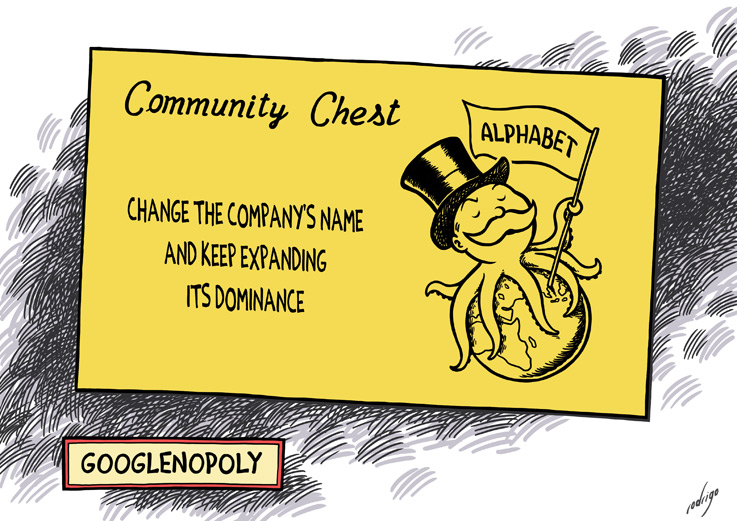
Rodrigo de Matos has made a cartoon that comments on the ABCs of Google’s new corporate mother: Community Chest (Googlenopoly)

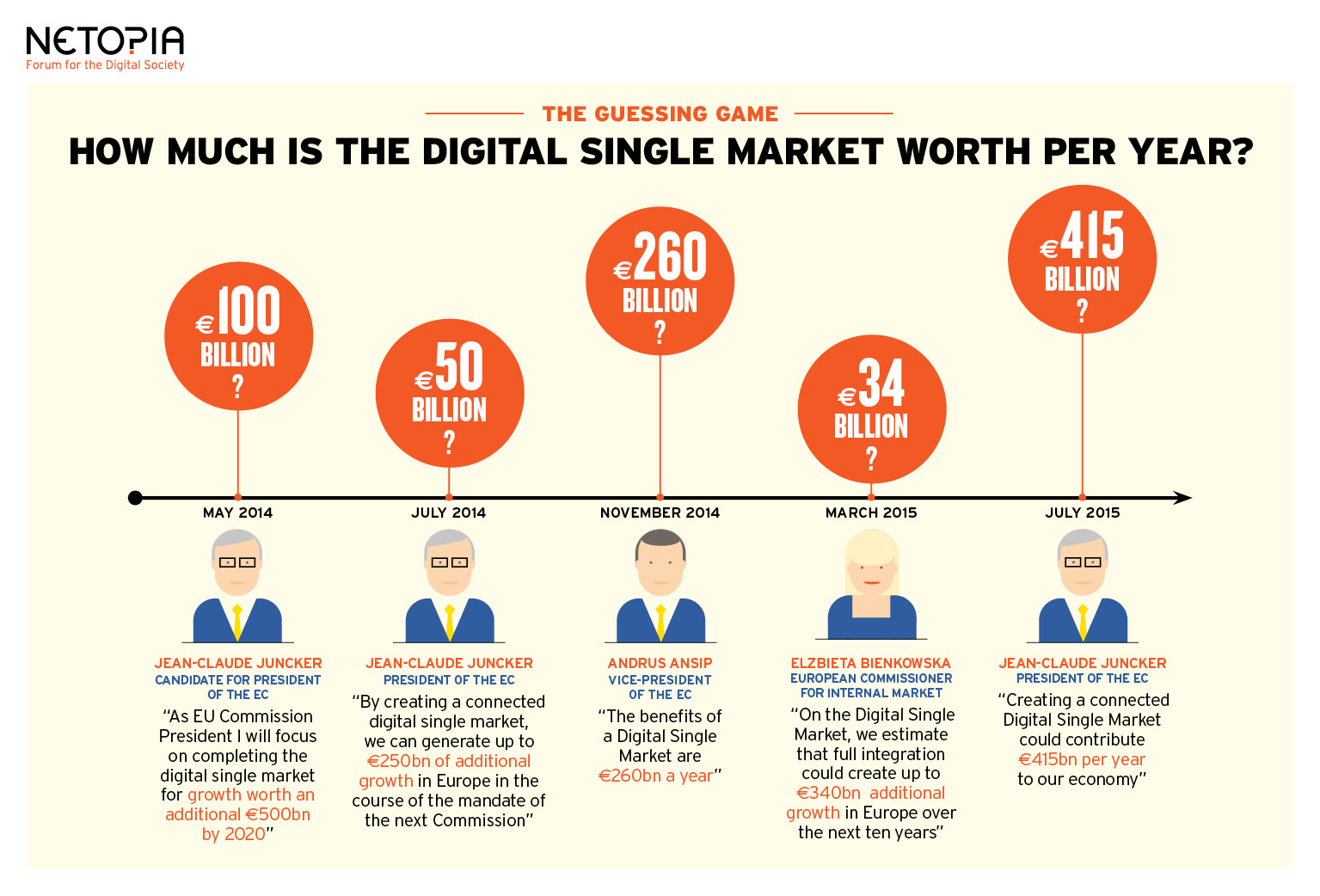
Infographics is another novelty, first out is The Guessing Game – with so many numbers on the expected value of the Digital Single Market from different commissioners, Netopia thinks it’s time for Juncker to bring his merry band to order, and not only about attending the College meetings. Of course, all these predictions conveniently disregard the point that the Digital Single Market will also take away a lot of value that currently exist, built into local offers. The film industry has been particularly vocal about this, but anything digital locally tailored is next in line (looking at you, finance sector!). The real value-add of the digital single market may very well be negative. Of course, economists will argue that this is a much-needed productivity increase in the shape of a Schumpeterean creative destruction and that growth will come. Fair point, but in a global economy, who can tell where that growth and those jobs will arrive? What if other parts of the world have a head start in the digital race (looking at you, Silicon Valley!)? So it may be that Europe’s digital upper hand is in diversity and content, rather than concentration and dominant platforms. If that is the case, the numbers in the DSM guessing game may very well be upside down and the recipe for jobs and growth in Europe something different altogether (looking at you, creative SMEs!). Netopia welcomes the Digital Single Market proposal, not because we like it, but because it brings the digital topics center stage in the EU-bubble. With the make-over, Netopia is right there in the spotlight.

Enjoy!

“Paid Services May Be Google’s Future”

Friday, October 2nd, 2015

Google chief economist Hal Varian recently spoke to an audience of industrialists, bankers, journalists and academics at the SNS Finance Panel in Stockholm. Netopia was there.

STOCKHOLM Professor Varian’s main message concerned how big data services can be useful for both businesses who want to better understand their consumers as well as governments looking at inflation goals or public elections. By combining tools like Google Trends, Google Correlate, and Google Consumer Survey, marketers can learn things like how a preference for American-assembled products correlates to searches for Chevrolet trucks and country music. Yes, you had a hunch, but Google has the evidence demonstrated Varian as he showcased the tools.

Governments can use data on searches for unemployment benefits to predict recessions. This does not compete with regular government statistics, but can work as a complement to better understand them or to get advance indications, suggested Hal Varian.

Professor Varian also offered a new word: HPPOs, or hippos: Highly Paid People’s Opinions. Google’s tools offer the choice of an experiment rather than relying on hippos, at least in some cases. In other cases, experience and judgement can be more important, according to Hal Varian. Netopia took the opportunity to ask about the sustainability of Google’s business models:

Is the demand for advertising endless? Can Google grow infinitely on mainly ad revenue?

Varian: – Excellent question! Is advertising endless? Most people would say there is too much of it. Look at commercial television. The ad revenue per viewer is about 25 cents per hour. Most people would rather pay the 25 cents and not watch the commercials. Finer, better-targeted ads are more accepted. But attention is a scarce factor. We want to see less advertising, not more. In the long term, we [Google] may move toward paid services. Until then, we should make ads more specific and more targeted.

The Mixed Blessing of Unlimited Distribution or Does the Appstore Need a Make-Over?

Monday, August 31st, 2015

Gamescom is the world’s biggest games show. It brings 400 000 gamers to the Cologne Fair every August where they spend hours in line to get a 15-20 minute sample of upcoming game hits like Star Wars: Battlefront or the next Just Dance. I go every year (you can too, it’s fun and tickets are cheap!).

Besides the AAA-blockbusters, the big success story in games in the last decade are mobile games – just like web users, gamers move to mobile. It’s a trajectory that sets the global games market value to an expected 83 billion US$ next year. The Iphone and the Appstore set that ball in motion in 2008, when it not only provided game developers with a simple and powerful target platform, but also a delivery service with integrated payment – solving most of the mobile games industry’s problems in one move. Some game developers I know used to talk about the Iphone as “the Jesus phone”. But the Messianic image is being challenged by the Iphone’s own success.

At Gamescom this year, I met an industry veteran who now makes his living coaching game startups in the UK on business strategy. He had done the numbers on the Appstore’s games business. Last year, 95 000 games were released on the Appstore. That is more than ten new titles per hour, 24-7. The average production budget was $25 000 per game, but the average revenue only $5000. That means that mobile game developers lost a total of 1,9 billion US$ last year, only on the Appstore. Remember, this is the industry that was supposed to bring jobs and growth back to Europe. These numbers suggest that European app developers rather subsidise Apple’s profits and promote its hardware with their content.* The reality is probably worse, because the income distribution follows a long tail-graph rather than a Bell curve, so the median revenue for a game on the Appstore is very likely zero. There are lots of winners of course, some app games make lots of money for its developers, investors and Apple. Many of these titles are likely more ambitious so the media production budget may be lower than the 25KUS$. And there are for sure cheaper games that become surprise hits (looking at you, Flappy Bird!). But combined, the financial impact is destructive. Who knew?

My friend, the startup business coach, raised the idea that Apple should limit the number of titles on the Appstore. In a way, that would be similar to the old systems of entertainment content distribution, where the distributors where gatekeepers to the market. Except the old system of record labels and games publishers also invested money in the production and marketing of content. To some extent, Apple can promote titles on its system, contributing to the marketing and thereby picking the winners. But it doesn’t put any money into it. So what if the number of titles would be limited? If you’re a startup coach like my industry veteran friend, it makes sense to assume that the startups don’t know what’s good for them. But there may be others who would prefer to take their chances and try to beat the odds. Should Apple stop them from that? Would that be better? Maybe the answer is in Apple being a more active publisher, sharing risk with its suppliers, being transparent about promotion policies. Maybe the answer is in wiser startups. Maybe more startup coaches are needed. Whichever answer you prefer, the promise of unlimited distribution is a mixed blessing.

*) That is assuming the Apple customers like Euro app games, of course. Maybe they don’t. Maybe they could care less. I also understand that not all app game developers are European.